How to Choose the Right MS Pipe for Construction Projects
Why the Right MS Pipe for Construction Matters
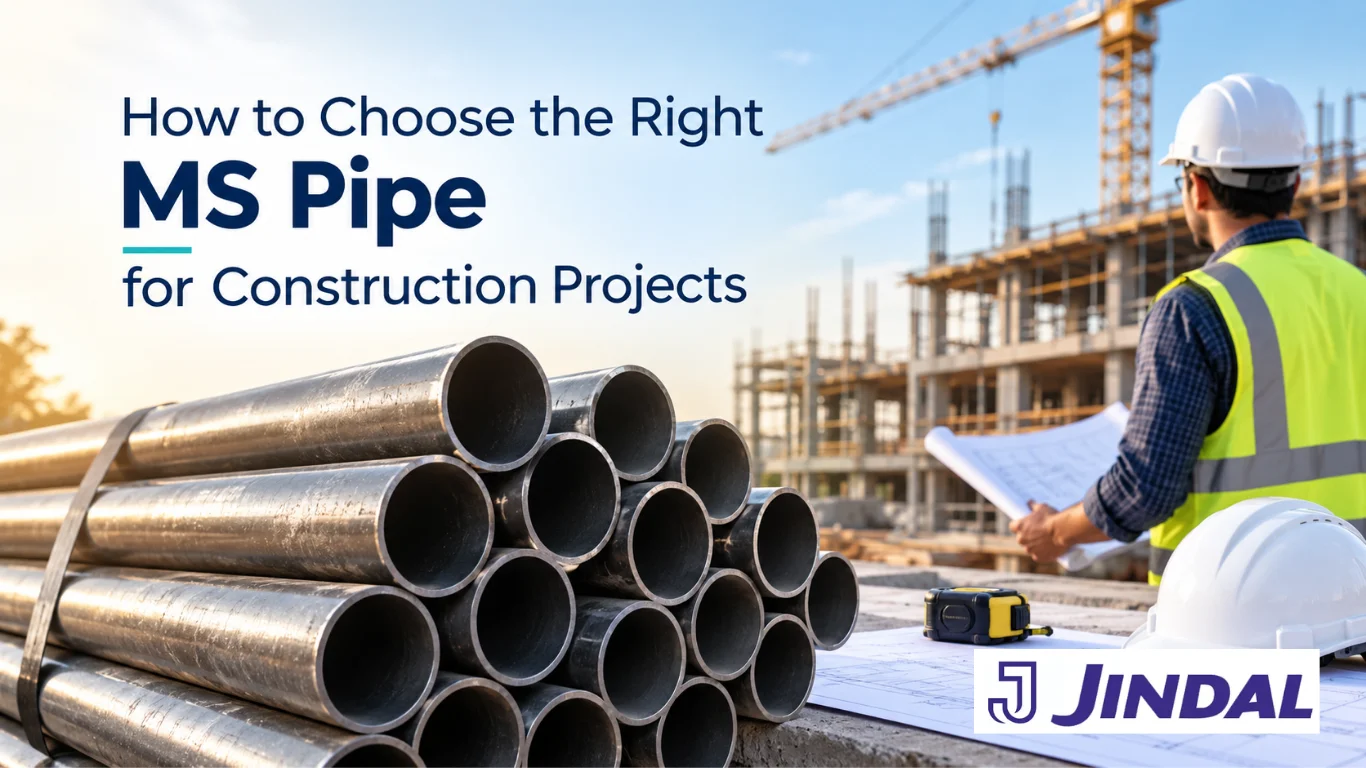
MS stands for mild steel. It’s strong, easy to weld and cost-effective, so you’ll find it on almost every building site in India, from structural frames to fire lines and sewage networks.
Still, “MS pipe” is a broad label. Two pipes can look identical yet differ in wall thickness, steel quality and coating. Those differences decide how long the pipe lasts and how much load or pressure it can take.
Step 1: Start With the Job the Pipe Has to Do
Before looking at sizes, ask what the pipe will carry or support.
- Structural work (frames, supports, scaffolding, sheds): you need strength and straightness. Look for tubes made to IS 1161, or hollow sections.
- Fluid lines (water, sewage, fire protection): you need sound welds and pressure capacity. IS 1239 (Part 1) is the usual reference.
- Poles and general fabrication: you need even wall thickness and a surface that welds and coats well.
A pipe that’s perfect for scaffolding may be wrong for a fire line. Decide the job first, then the size.
Step 2: Check the Indian Standard on the Pipe
IS numbers tell you what the pipe was made and tested against. For its MS black pipes and tubes, Jindal Supreme lists IS 1239 (Part 1), IS 3601, IS 1161 and IS 2713. In simple terms, IS 1239 covers pipes for water, gas, air and steam. IS 1161 covers structural tubes, IS 3601 mechanical and general engineering use, and IS 2713 tubular poles.
Don’t rely on a stamp alone. The BIS Care app lets you enter a licence number and check the manufacturer’s name, licence validity and products covered. The BIS product manual for IS 1239 (Part 1) explains the scope in detail. Check the licence scope too, because it lists the sizes and classes covered. Jindal Supreme’s, for example, covers IS 1239 pipes from 15 to 150 NB in light, medium and heavy classes, in black and galvanized finish.
Step 3: Understand MS Pipe Sizes, Thickness and Class
Nominal bore (NB) is a naming size, not an exact measurement. The real outer diameter is larger and is fixed in the standard’s tables. So write down the outer diameter and wall thickness when you order. “2-inch pipe” alone isn’t enough.
IS 1239 sorts pipes into light, medium and heavy classes by wall thickness. On many Indian sites you’ll spot them by colour bands: yellow for light, blue for medium and red for heavy. Medium and heavy pipes are generally the safer pick for underground laying, higher pressure and steam services.
Here’s a detail many buyers miss. The standard allows the wall to be slightly thinner than nominal: up to 8 percent for light tubes and 10 percent for medium and heavy ones. A certificate showing measured thickness avoids surprises.
Step 4: Choose Between Black and Galvanized Finish
Black MS pipe has a plain surface, usually with a thin oil or varnish coating. It suits indoor structural work and fabrication, or pipes you’ll paint later. The galvanized pipe is hot-dip coated in zinc. For GI pipe, IS 4736 sets a minimum zinc coating of 360 g/m², roughly 51 microns. That suits outdoor, damp and chemical-exposed locations.
A simple rule: if the pipe will meet moisture and won’t be painted, choose galvanized.
Step 5: Look at How the Pipe Is Made
Most MS pipes for building work are ERW pipes, meaning electric resistance welded. A steel coil is slit, formed into a tube and welded along the seam, and the weld is where quality shows. At Jindal Supreme, pipes go through slitting, forming, welding, heat treatment and inspection, using coils from JSW and Jindal Steel. The full manufacturing process is on its website.
Ask your supplier who supplies the coil and which tests are done. Typical checks include hydrostatic, eddy current, flattening, bend and flaring tests, plus chemical analysis.
Step 6: Ask for Test Certificates and Traceability
Paperwork carries real weight on government and EPC projects. A reliable supplier should provide material test reports, batch coding, heat number traceability and test certificates. Jindal Supreme states that it offers these, along with third-party inspection support.
A Quick Checklist for Choosing the Right MS Pipe for Construction
| Check | What to confirm |
|---|---|
| Application | Structural, fluid line, pole or fabrication |
| Standard | IS 1239, IS 1161, IS 3601 or IS 2713 |
| Size | Nominal bore and actual outer diameter |
| Thickness and class | Light, medium or heavy; measured wall thickness |
| Finish | Black or galvanized (zinc coating thickness) |
| Paperwork | Test certificate, heat number, verified BIS licence |
Why Builders Choose Jindal Supreme MS Pipes
Jindal Supreme began with a single tube mill in Hisar in 1974. Today its 16-acre plant offers 90,000 MTPA of MS black pipe capacity in sizes from half an inch to 10 inch, an in-house testing laboratory and three galvanizing lines. Its pipes have supported water supply and construction work, including projects linked to Jal Jeevan Mission and PMAY. See the infrastructure and construction projects it supplies.
Not sure which pipe suits your site? Contact our team or download the product catalogue for full specifications.
Final Thoughts
The right MS pipe for construction isn’t the cheapest or the thickest. It’s the one that fits the job, meets the correct IS standard, carries the right coating and comes with paperwork you can verify. For wider updates on India’s steel sector, the Ministry of Steel is a useful reference.
Frequently Asked Questions
Which MS pipe is best for building construction?
It depends on the use. For structural frames, choose tubes made to IS 1161. For water, sewage or fire lines, medium or heavy class pipes under IS 1239 (Part 1) are the safer choice.
What is the difference between MS pipe and GI pipe?
A GI pipe is an MS pipe coated in zinc through hot-dip galvanizing. The zinc protects against rust, so GI suits outdoor and damp locations, while black MS pipe suits indoor or painted use.
What do light, medium and heavy classes mean in MS pipes?
They describe wall thickness under IS 1239, from thinnest (light) to thickest (heavy). Medium and heavy classes are preferred for underground lines and higher-pressure or steam services.
Which IS code applies to MS pipes?
IS 1239 (Part 1) is the main one for tubes carrying water, gas, air and steam. IS 1161 covers structural tubes and IS 2713 covers tubular poles.
How can I check if an MS pipe is BIS certified?
Enter the licence number marked on the pipe in the BIS Care app. It shows the manufacturer’s name, licence validity and products covered. If no record appears, ask the supplier to clarify before buying.